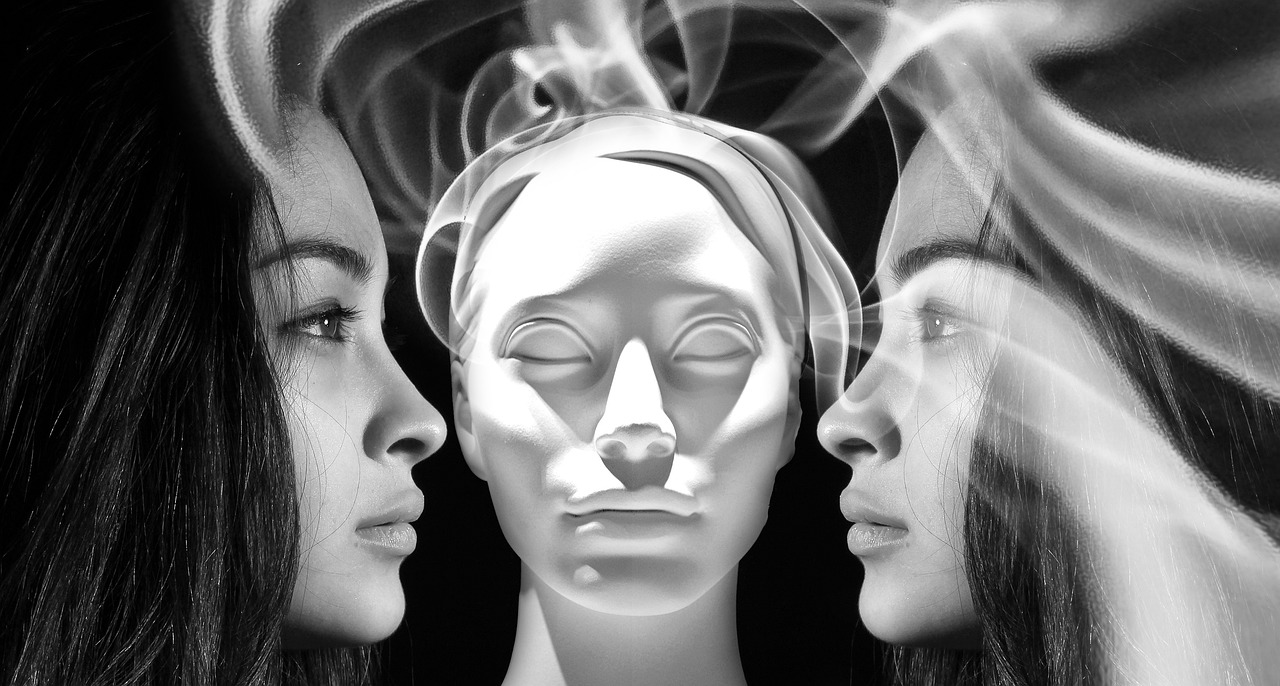
Image by Gerd Altmann from Pixabay. With thanks.
He could kill me this time. Before the blow that never comes, I leave. In the no-man’s land between now, and the awareness of now, I withdraw from my body. From the feet upwards, until I exit, like breath, from the back of my head. A gossamer shroud. A whisper of consciousness. A fragile, indestructible translucence that is I.
Then the iron poker in his hand slams onto the carpet and bends like soft lead, and I realise that it has not come down on my head.
It is a memory. An image with no physical sensations. A video devoid of emotional content. Yet I trust it. A memory that has endured through long years, appearing not to have changed, to be immutable. A composite of linked events that happened. A solid, credible, incredible reality.
But between the leaving and the realising did time skip a beat? Did reality slip through the interval into non-existence? Because, when and how did I return?
It had happened before. When I was seven. Not gently sliding out, but ripped asunder. The interval through which reality slipped that time was long. Thirty five years long. Time skipped not just a beat but a whole symphony was lost. Life is kind, it does its best to protect you. At some unrealised level you decide, better I don’t know what I know. Better I forget that I ever knew. Better I bury it so deep as to have no memory at all. Better my reality is so solid I can be absolutely sure that sexual abuse never happened to me.
Except just one thing.
I am looking down from the ceiling at a body lying twisted on a bed, eyes wide open. And I am curious as I look into those staring, lifeless eyes that I do not recognise as mine.
Unlike the events that actually caused the dissociation, throughout those long years of ignorance and forgetfulness, I don’t think that I ever forgot this disturbing image of returning to my body. A fluttering flag marking the spot where something was hidden deep within the ground of my being. A puzzling fragment, unattached to anything identifiable that surfaced occasionally in moments when my mind was lull
So when—unknowingly; accidentally; innocently— I dug around the flag and opened a crack in the crust of my world, memories erupted along the fault line of my childhood. They flickered in cinemascope across the screen of my conscious mind and I watched, nonplussed. Strange, unrelated flashes of scenes and feelings, and the words—sexual abuse—like a film title encapsulating a story. Where? When? Who? And I was sitting on the stairs. I knew whose house it was. I knew when it was. I knew who it was.
But not much more. Just sensations of being covered. Feeling insecure and frightened. Remembering that I used to think, when going for a pee, that a hand with a knife would come upwards and pierce me. And my mother putting cream on my genitals which she was surprised were so sore, as I lay on her bed staring out of the window. But I didn’t remember the leaving of my body to pair with the image of returning to it that my consciousness had kept with me.
There is mercy in forgetfulness.
There was no smoking gun. No fully remembered scenes. No he did this then I did that.
Were those real events that actually happened and were subsequently forgotten, or did they only play hide-and-seek in my imagination? In my hippocampus that juggles what might have been, what has been and what will be. Where the ball of memory rattles between the three cups of illusion, imagination and reality. Does imagination peep out in unexpected places where reality has taken it. Or perhaps it is reality that rolls forward from where illusion has pushed it.
I have asked myself many times what is the criteria for deciding on whether something was real or not real? I watched my desire to know influence what I thought I knew. I observed myself patching together half remembered conversations and scenes. I felt myself imbue memories with significance. I heard phrases echo down the years and gave them new meanings.
But all of that does not prove anything at all. And I knew it. Like a will o’ the wisp that floats enticingly above the bog, it draws me in deeper and deeper until I am drowning in a world of my own imagining, whose dreaming images ebb and flow with possibility. A place where I half intuit that I left my body and talked to angels who sent me back. Or where I was carried down a corridor with green tiles on the wall, or I shrank into a corner trying to disappear. Or the phrase, “don’t make a fuss, darling” is filled with significance as my mother prepares to drop me off at the babysitters.
But if you ask me now, were you abused as a child? I will answer yes, I was. Even though the evidence is sparse, how it was obtained is the proof. There are things that I am willing to trust. The first being that I did not actively imagine the first flashbacks, thirty-five years after the event. The scenes played out in front of me, and I was an astonished and confused spectator. And secondly, I have two body memories. Sitting in a chair one day, I moved involuntarily and as I did it, I knew when I had done it before, because I am there in the bedroom, scrambling back across the bed to the wall and I feel the terror and the desperation. And again, lying down, I suddenly knew that my hands and feet had drummed impossibly fast on the floor and I was screaming in hysteria, only to be slapped across the face twice.
Can I hang a reality on those three things, and say that definitely this happened? And if I do, what does that mean to me, so many years later? Or does it even matter whether it happened in reality? I allow myself to trust in the reality of those things because of their involuntary nature. As though they happened from the outside in, not, like the recollection of memory, from the inside out.
But what am I saying if I think like that? That only the things experienced through my body, unwilled, are definitely real. Then am I real? The I that left my body: the gossamer shroud; the whisper of consciousness; the fragile indestructible translucence. Was that just imagination? Because what am I, as a personality, except the recollection of memory?


 Salatheel