
Cordoba has always been a melting pot and today is no different. We wander through streets thick with milling tourists, and for the first time we have struck gold with the marketing opportunities. Tacky tourist shops line the narrow streets. Tiles and dolls, frocks and leather vie for attention. All very expensive and very, very nasty.
The languages flow around us. German, Dutch, English and a smattering of American. A couple from the Bronx argue as they push their way through the crowd. We sit down at a cafe and the table next door fills with a laughing foursome. Must be Italians. Even the discerning French are here en masse. Flocks of French schoolchildren are herded by a few barking sheep-dog teachers.
Today is a day of magnanimity on my part. My friend gets to choose the itinerary. Since we have arrived I have route marched her, whisked her away to obscure locations, dragged her into buildings hardly meriting a mention in the tourist guides, all in the name of a figment of my imagination, a story. But this time she gets to choose, and we are going Islamic. Not even a sniff of Napoleonic.
The Romans were in Cordoba and their grandeur mingles with the Arabs who followed them, the Jews who kept them company and finally the Christians who bludgeoned their way onto the scene around the turn of the first millennium.
Whilst northern Europe was a wild, cold territory fought over by Vikings, Visigoths and Saxon warlords, pillaging and slaughtering their way to power, Cordoba was the largest city in southern Europe, with one million people and the centre of everything cultured, educated and liberal.
We go to the astounding creation that is Cordoba Cathedral. It is not a cathedral, it is really a mosque, whose proportions and beauty so captured the Christian King that conquered the city that he instructed his Muslim architect to construct a church inside it. It is unique, it is beautiful and it is worth travelling across Europe and over the seas to see.
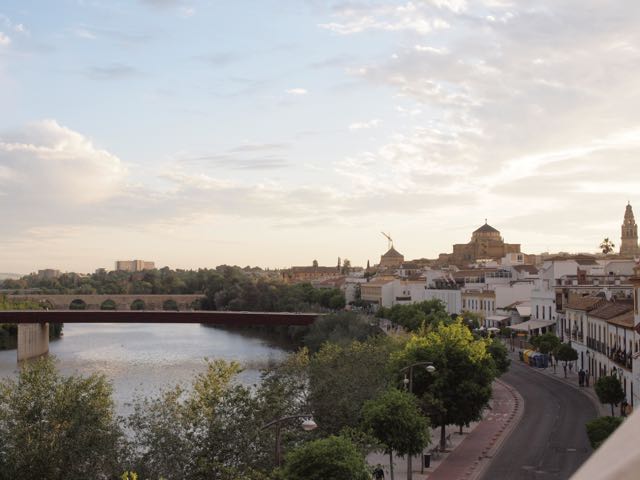
It must be worth a photograph, I hear you think. Indeed it was worth very many, but a technical malfunction has wiped all the photographs from my camera for this day. There we were, two old dears, trying send just one photo from my friend’s iPhone to my Macbook. She’s locked out of her email with no phone access (don’t ask, too complicated) but we do have wi-fi. We tried bluetooth and dropbox, but her phone just won’t play, so sorry folks, stock photos only. But I encourage you to google images for Cordoba mosque
From the choked streets, we turn into a narrow alleyway. Everything is white, and suddenly peace descends. The hubbub is gone and we have turned into the old Jewish quarter, where there is a Jewish museum. A little further down is a house that has been restored to show its 11th century origins. It is simple and exotic rugs hang on the wall, water bubbles in a low marble fountain. Plants climb the walls of the courtyard and underneath is a cellar with a well and an old plough doing the service of a handrail on the steps. It tells the story of how paper was made from rags, scraps of the Egyptian cotton used at the time.
From there, via an appropriate lunch of Middle Eastern food we cross the Roman footbridge to the tower and go into the museum. We take an audio tour narrated by someone who was obviously sent to be educated in an expensive English public school (private school). In just 8 rooms we view the splendour and civilisation that was Moorish culture in Spain. We listen to the philosophies of the three religions that all preached peace and harmony. Whilst elsewhere the crusades raged across the Middle East. We view sophisticated and beautifully made surgical instruments and see astrolabes and world maps. It is intelligently put together and very informative, no dumbing down here.
Tomorrow we leave for Madrid and Napoleon will stick his foot in the door again. And we will never know exactly what that peculiar thing we could see under the bridge, actually was.
 Salatheel