The Style Police

I was thinking today about writing style and the Style Police in general.

Photo courtesy of bethrosengard on Pixabay

scrabble-tiles-bethrosengardI must admit that as soon as someone says (and it is amazing how often they do), “You can’t do that”, I’m always tempted to go and find a brilliant author, universally acknowledged to be in want of a citation and reply, “Oh, how unfortunate, Jane Austen does that, and here’s me thinking she was a great writer.”

In reality, you can do anything you damn well please. The rule in my book, is to understand the rules, stick to them in general and then when you break them, do it with purpose and aplomb.

What you need to know is what happens when you break the rule. Every choice of style has its positives and negatives. Take long sentences for instance, currently universally reviled. They involve the reader engaging their brains to a higher degree, as they need to bear in mind important information from the beginning of the sentence, so that as they progress through it towards the inevitable ending, they can build the composite world which is being revealed. I am told that no-one these days is interested in engaging their brains and readers need to be spoon fed in snippets to suit their teeming brains. How insulting. What does a long sentence allow you to do? It gives the author the chance to unfold linking meanings and nested possibilities in a fluid way, with which the chop-chop of short sentence construction can never compete. Try reading a good academic journal article and you will see what I mean. (Or even Jane Austen…)

But, of course, it needs to be born in mind that long sentences require a highly developed understanding of the use of punctuation. So if, like me, you’re a bit hopeless with that side of things and barely know where to put a comma, hyphen or ellipsis, let alone an em-dash or god forbid, a semi-colon, then perhaps it’s best to leave well alone. Stick to the single idea stuff.

However, let’s not get sniffy about short sentences either. How wonderfully tight they can be. Winding up the action until you can barely breathe. Punchy and wonderfully staccato. That last sentence, wasn’t even a sentence at all. My grammar checker (the electronic version of the style police) was very superior, calling it a fragment and insisting I put in a verb. But saying, “They are punchy and wonderfully staccato” is simply not punchy and wonderfully staccato. If I’d made a whole long sentence, “Winding up the action until you can barely breathe; punchy and wonderfully staccato.” it would have been perfectly happy, but I would not.

Now, there’s another punctuation conundrum for you. I had to put a capital letter and a full stop in the middle of that last sentence in order to make the point. So here is the question. Should the word “then” which followed the quote, have a capital letter or not? Any Style Police out there who can help me here?
I just skipped the description, I didn’t miss much… Did I?

No-one wants descriptions these days, they haven’t got the patience. Oh God, great long boring description. I skipped it. Didn’t miss much.

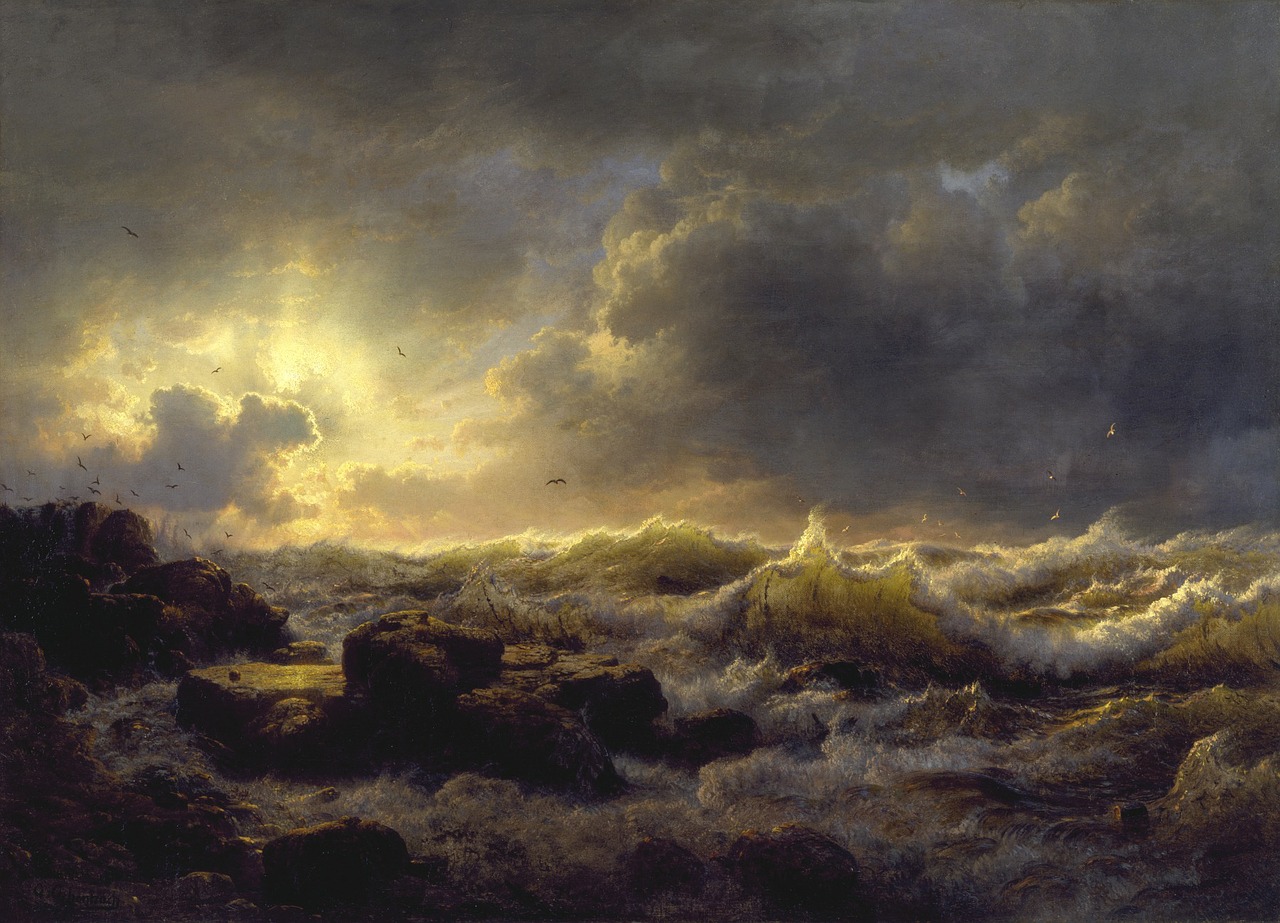
I was just thinking how fortunate we are to have such a wonderful luxury. In the past reading was one of the affordable pleasures and Dickens published his work in a series of magazines which were not too expensive. But at that time travel was prohibitively expensive, so there were plenty of people who had never seen the sea (there still are…) How were they to imagine the raging storm in which Ham drowned in David Copperfield? Only if Dickens described it for them.

Painting by Andreas Achenbach (1815-1910) Probably painted around the same time as Dickens was writing. (don't quote me on that) Picture courtesy of tpsdave Pixabay.com
Painting by Andreas Achenbach (1815-1910) Probably painted around the time Dickens was writing David Copperfield. (Don’t quote me on that) Picture courtesy of tpsdave Pixabay.com

Or If they lived out woop-woop, how would they conjure the towering heights of the skyscrapers in a New York City they had never visited. And without the help of Fantasy Gaming, what would Ghormenghast look like if it wasn’t described by the pen of a Master?

Nowadays, images of things we have never personally witnessed are flashed before us in a thronging procession of fact and fiction. We have a visual and sometimes an aural feast relentlessly thrust at us  in two dimensions on screens varying from a few centimetres to tens of metres. We assume that we know what a thing is, because we have seen it. We are presented with a word and our brains click into overdrive with pictures and possibilities.

Desert – and there it is, in all the glory of Lawrence of Arabia, or perhaps a news video of war in the middle east, or famine in Africa. Yep, I know desert, now get on with it, what’s next …

Probably not what you had imagined, given the word desert. Picture courtesy of SamCurry Pixabay.com
Possibly not what you had imagined, given the word “desert”.
Picture courtesy of SamCurry Pixabay.com

What we know is an image of a desert. What we may not know, unless we have been to one, is the smell of the desert, the sound of the desert, the searing heat or freezing cold of the desert, or how a desert can sap your strength and deceive your senses. Our eyes, always dominant, always arrogant, think they know it all. And trampled underfoot are all the other senses and the delicious wonder of an unfolding description that takes you–all of you–into the heart of itself. The wondrous art of loading words with sensual meaning, that takes you far below the superficial look of something, to wrap you up in its soul.

But isn’t that just, so today – never mind the depth, just skim the surface. There’s nothing but murk down there anyway.

Viva! Virginia Woolf, Émile Zola, Tolstoy and Dostoyevsky et al and the long, delectable, all-consuming description.

Just waiting for the plot to clot

Photo: courtesy of tanertosun; Pixabay.com

I have come to a hiatus again. I don’t call it writer’s block. That makes it seem as though  you can always be rattling the keys (or pushing the pen). As though  writing fiction streams out like water through a pipe. You sit down, turn on the tap, write, then turn it off and go away and think about the shopping until the next time.

For me, writing is a lumpy process. It forms clots around the available plot. When there is no plot available it runs thin. It’s not that I don’t know what will happen, it’s rather that I’m not sure how it will happen. And in the difference between what and how, lies the gulf between humdrum and predictable or exciting and unexpected.

I have convinced myself that it is a self evident truth that if you work out a plot using your logical, rational left brain, then any reader can work it out too. Whether this is true or not, is a moot point, but I am locked into that way of thinking, so for me it is a given. Hence, I rely on my unpredictable, spasmodic and erratic right brain to provide me with direction, and at the moment it is twisting itself into knots of unknowing. The more you try to make it happen, the more constipated it feels.

Yet I also have this wonderful confidence that something is brewing. The more I relish the expectation of it, the more excited I get. And when it finally emerges, I know from experience that it will seem as though it was always there, just waiting to be discovered. The right brain is like that: timeless and forever pregnant with a swirling potential, just waiting for a clot to form.

England’s green and pleasant land

Field of rape in Lincolnshire
Lincolnshire farmland

When tourists go to a country they look for the spectacular, the noteworthy, the interesting. They congregate in the Cordobas and the Lake Districts of the world. They do not generally partake of the fields that form the agricultural breadbasket or the cities that provide the manufacturing jobs in a country.

Spring Green, Norfolk

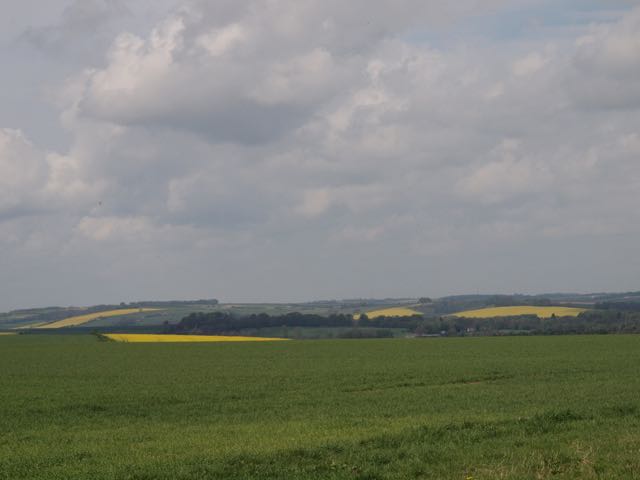
But I am visiting friends and family who live in the quiet of the rural heartland, where the land is carved into fields as far as the eye can see and the sky arcs overhead in its immensity. The rape is in bloom and it splats itself yellow and vibrant amongst the green fields of the young wheat.

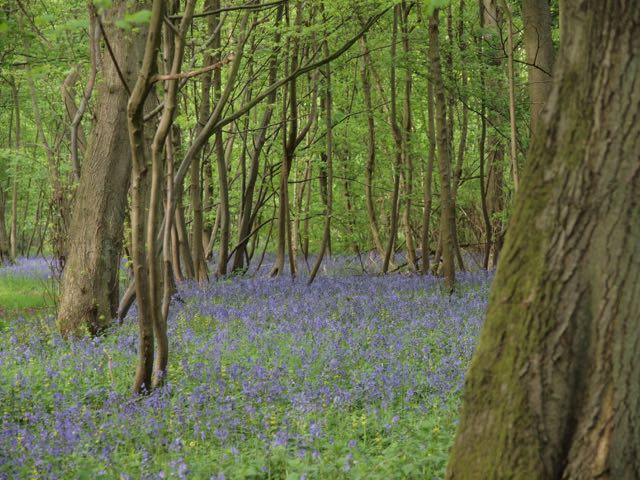
The trees have new leaves and they are a succulent yellow-green, vibrant and fresh. Whilst under the canopies in the woods, the bluebells mass.

Bluebell Woods, Norfolk

As we drive along narrow roads, bordered by hawthorn hedges, neatly clipped and newly sprouting, I am struck by the fecundity of it all. Warm brick houses still sit in the landscape just as they were when John Constable depicted them in his idyllic scenes at the start of the nineteenth century. A pastoral heaven, a Garden of Eden.

Fields of beans and rape, Norfolk

I feel cocooned by nature in her abundance. Here it seems as if life is easy. The fruits of nature ripen and drop into your hand in “England’s green and pleasant land”. How different to the scenes further north, in the highlands of Scotland and the windswept Pennines, where nature does not condescend to notice you, or provide for you. You are permitted by her to scratch out a living where you can and no quarter is given in the battle to survive.

And perhaps you can see the effect of that indifference in the prevailing character of the people. They are tough, no nonsense, thick-skinned people, for whom a sense of humour is as important to survival as food on the table and warm clothes. They had strict rules of hospitality, and gave generously, because they knew that death was just a cold exposed night away and there but for the grace of God goes any one of them.

Pink Campion
Pink Campion

The Lincolnshire Fens and Norfolk Broads were drained by Dutch engineers in the early seventeenth century, and rich landowners have tilled the fertile soil and lived comfortably for some four hundred years. There is still an air of affluence in the neat gardens and the middle-class residents who spread from London to this gentle landscape, still commutable to the capital.

Learner drivers and the art of the double declutch

My friends and family are in mourning: the Conservatives have sailed home with a workable majority and the Scottish National Party has all but obliterated Labour in Scotland.

Newton's Apple 4 (Jamie Hedworth) Tags: england sculpture apple hand gravity isaacnewton grantham linconshire wyndampark jamiehedworthphotographyAnd I have come home to the Tory heartland, to the town of my birth, a distinction that I share with Margaret Thatcher. It pleases me to be able to report that the statue to the Wicked Witch has not been erected in Grantham, as the good townsfolk opposed it. So hearteningly, even Tory voters have lines over which they will not cross. There is however, a stunning sculpture in the park to its other famous child, Isaac Newton. The stump of a felled sweet chestnut tree was sculpted into a hand and an apple carved in elm was placed within its fingers. (Photo courtesy of Jamie Hedworth on Flickrhivemind)

To mitigate our gloom we went on a little jaunt around the countryside. Out across the Lincolnshire Fens where, during the Second World War, the fighters and bombers were based. Airfields are still scattered amongst the fields with a liberal hand. In my youth I remember my first attempt at driving, up on an old airfield outside the town. The lad had an old van, and we started at one end of the runway and I must have got into second by the time we reached the other end. What he failed to explain before I tried to negotiate the turn was that I needed to double declutch (for those unversed in the traditions of archaic driving terms, here is a link that explains the mechanics of it nicely.) We turn towards the hangar and are still turning back onto the grass beside the runway as I two-step on the pedals in a slow dance of saturated incomprehension.

‘Right,’ he says, maintaining confidence in my abilities. A stance that he probably hopes will endear him to me. ‘We’ll have to reverse out of it.’

‘Well are you sure, why don’t you do it, I –’

‘No you’ll be fine, you can do it.’

Gear-stick into reverse, rev the engine, ‘No, turn the wheel the other way,’ off we go. We are trundling, ‘Brake now’, I jam on the anchors, we are still trundling, ‘Put your foot on the brake’, we are still trundling, ‘Brake!’ If we were going faster, at this point there would have been a spectacular handbrake turn. As it was the impact with the hangar doors was a grinding bump.

He looks at me accusingly, all confidence in my abilities obliterated. ‘Why didn’t you brake?’

‘I did.’

‘No you didn’t.’

‘Yes I did.’

There is a moment of tense silence before he opens the door and looks under the car then under the bonnet. ‘Hmmm, the brakes have gone. Shift over, I’ll drive.’

We trundle off again, down the runway and out onto the road. We pootle along. ‘You see we’ve got this problem,’ he says airily. ‘We have to go down the hill into Grantham and there’s a T junction at the bottom, so just open the door and if I say jump, then jump.’

Doors open we weave like a shuttle in a loom from one side of the road to the other and up the grassy verges. The T junction looms. We take a deep breath. It is Sunday afternoon in a small town. What happens on Sunday afternoons all across the Christian world. Absolutely nothing…

Leeds leads

The Leeds Owl
The Leeds Owl

We arrived back from Spain at 11:30pm. The booked taxi did turn up and we careered through the Yorkshire countryside, rolling around in the back seat. We fell 23 degrees C in three hours, down to a welcome of three miserly degrees above freezing.

Why are butchers always cheery? As I brought a couple of pork chops this morning he replied cheerfully to my comment that we had just come from the sunshine with, “It snowed here last week.”

For various very good reasons concerning tickets and cameras I wandered into Leeds city centre on a Saturday. It was all of 8 degrees and drizzling. If there were no other words to describe rain, drizzle would suffice for most days of the year in England. It was packed with flat Yorkshire accents, milling in the shopping centres with coats half open to reveal scantily clad midriffs and hairy paunches.

One has to hand it to Leeds City Council (Labour/socialist), they have always had vision and have managed to create a thriving city even in the midst of recessions. When I first came to live here in the early seventies, Leeds was a crumbling decaying city of failing or deserted factories and slum clearances. I remember in the recession of the mid to late 80s, that there were no less than 17 office blocks under construction on my route to work. I thought they were mad.

But Jon Trickett, elected Leader of the Council in 1989 and now Labour MP for Hemsworth (or Tricky Trickett as we used to call him for self explanatory reasons) obviously knew a thing or two more about it than me.

He created a commercial hub that blossomed in the 90s. He also had the ‘novel’ idea that city centres should be lived in, as they are in Europe. In came planning permission for loft apartments and office conversions. Leeds University became THE place to go to University . Why? The best nightclubs in the country of course. They even used to do special excursions up from London for a Saturday night out.

When Harvey Nicholls (very, very posh department store) chose the location for their only other branch outside London, they chose – yes, Leeds. I understand that it currently makes more profit than its southern branch to boot. When the GFC hit, the newest Leeds shopping centre (and there are already many) was still under construction. Unlike the rest of the shopping centres being built across Europe, this one was not axed but completed. And it is heaving. Leeds is now the shopping Mecca for the whole of the north of England.

I cannot but applaud politicians who are willing to take calculated risks. These days, in the western world, we live in an atmosphere of fear and appeasement, where faceless focus groups and opinion polls dictate self-centred policy, and the spin-doctors move the mouths of MPs like ventriloquist’s dummies. It is policy by consensus – not political consensus, but the consensus of people whose world is as small as the price of their house, getting the latest mobile phone and keeping everything risk free.

The result is bland, bland, bland, reactionary and stationary. Where would Leeds be now if Tricky Trickett hadn’t put his money where his mouth was – it’d be mouldering in the doldrums halfway down the Championship League with Leeds United, that’s where.