A Celtic View

OLYMPUS DIGITAL CAMERA

Visiting the Celtic countries is always a sobering experience for an English woman interested in history. The long and bloody past of the Irish has always hung heavy on me. I came to understand quite clearly, with the instinct that a teenager has for bull-shit, the meaning of the word propaganda. I knew I was only getting one side of the troubles that raged just across the Irish Sea, but no-one in school taught me about the history that had created them. That I had to find out for myself.

Now I have travelled to another country with a chequered history of dispute with the English: Scotland. At least geography and perhaps a wild ferocity was on their side. Even the Romans feared to tread and built a wall beyond which, as my Scottish friend commented, dragons be.

Stirling Castle is the northern point of a triangle made with Edinburgh and Glasgow. It sits on a rocky promontory above the plain through which the River Forth meanders. Seen from the motorway its craggy heights scream defensive position and indeed, it was fought over no less that thirteen times in its history. Take Stirling and you take Scotland.

Now it is regularly taken by a host of unarmed (except for ice-creams) visitors who mingle with ladies and gentlemen dressed in period costumes composed of cheap synthetics and no petticoats. (No, I didn’t say fur coats and no knickers.) Indeed my friend and I had an in-depth conversation with Bishop David (long pause whilst the name continues to elude me) regarding the intrigue at the Stewart court.

Eagle Owl
Eagle Owl

Out in the Queen Ann Garden, a man displays his birds of prey. They sit on their perches regarding us with the steady watchfulness of accomplished hunters. Yes, he says to a little girl, you can stroke the birds, but in return the cute little falcon will demand payment of a lump of your flesh. She doesn’t quite understand and her face takes on the confusion and wariness of the hunted. He continues to expound enthusiastically upon the nature of of his beasts, pecking out his sentences with a ferocity that almost draws blood.

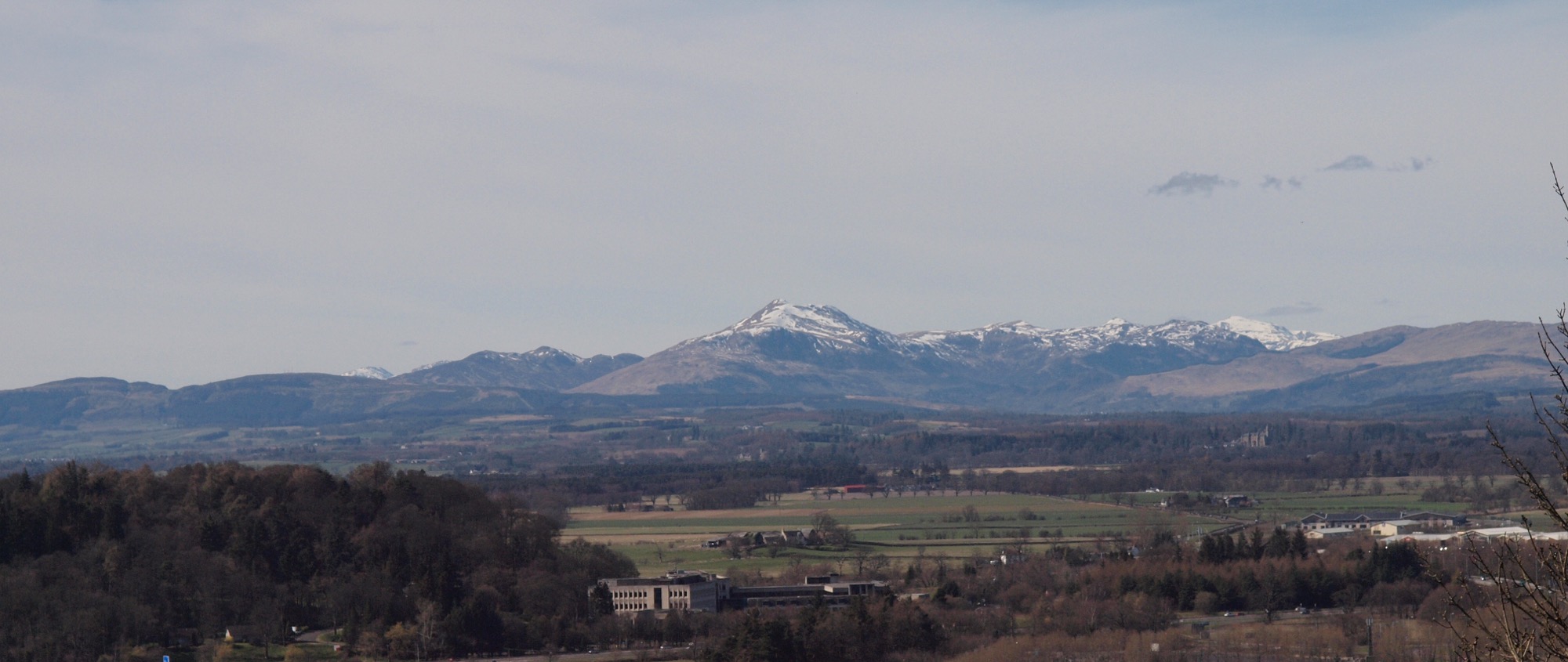
We stand next to cannons dated from 1810 which have been emasculated and painted in a beautiful uniform glossy black, and stare out at the hills and mountains rising around us. Snow capped and dressed in their winter colours, a reminder of the terrain which the Scots warriors used so skilfully to their advantage. And in which, the treachery of Glencoe, still leaves a winter chill.

Marsh’s Library

Marsh’s Library

Marsh’s Library was founded in the early eighteenth century by Archbishop Narcissus Marsh (1638-1713).

The smell of ancient books; fusty, dusty and acrid. So deliciously noxious. As though with every breath, particles of history sweep into your lungs and enter your bloodstream. Mr Joyce (James of course) met Mr Stoker (nephew to Mr Bram Stoker that is) in October 1902 in the reading room. Apparently there were eleven people crammed around the small table on that day. Quite a crush, for a library that had gone out of fashion.

But Mr Joyce and Mr Stoker were that real thing – readers of the books. Now, we are only allowed to look at the outside of the tomes that have survived for a further hundred years. The earliest are now five hundred years old. What a different world they tell of. A world dominated by religion and mystery, where the word “God” was almost the only answer you needed.

But Mr Newton, following in the questioning footsteps of Signor Galileo and Herr Kepler, wrote the Principia, (a first edition of which sits on these library shelves) and the answers multiplied again, and again, and again…

There are answers and there are answers, and it appears that the more speculative the answer, the smaller the book needed to contain it and the higher up on the bowed oak shelves you will find it. Slim volumes of controversy jostle one another for supremacy along the top shelf–isn’t that always where the “specialist” books are found…

In the glass topped cases, dotted along the central aisle, some of the prouder books display their frontispieces. The inks, a mixture of carbon and gum arabic, have not lost their colour like the oak gall writing inks of their day. The reds and blacks lie within the crisp lines of the letters, as sharp as the day they came off the press, when another Elizabeth was queen. Neither have they bled into the vellum, which seems so very fine and smooth that I marvel at the skills of the craftsmen that created it.

For how much longer will fine bound volumes find their way onto library shelves. Or will these five hundred years come to be known as the age of books.

In Dublin’s fair city …

Can a city still be fair when viewed through a veil of rain and hail? It is a moot point, and on one of my more uncharitable days, I might come down on the side of no. However, I am very far from feeling uncharitable about having left the warm climes to land on this frozen island.

Dublin greets you with a wealth of stately architecture and randomly twisting streets. Only O’Connell Street runs straight as a dye down to the River Liffe, once over the bridge the curvaceous streets around Trinity College invite you on a meander through history. Graceful Georgian stone claims the street frontage with Grecian columns and broad steps, jostled about by busy Victorian brick with elaborate porticoes. It rises high around you in narrow one-way streets, where cars come from every side and the press of pedestrians criss-cross oblivious to little green men, and red ones too.

It is cold and windy and everyone wears regulation black, brown or navy blue. As though colour has been banned for the season in case it reminds you of what you are missing. The grime of mud huddles around lamp-posts and presses itself into the the cracks where walls meet paving stones. And we all grit our teeth, straining for Spring, just one last surge up and over the parapets and surely we will shake off the long, smothering, siege of Winter.

I meet my friend for lunch in the Art Gallery, and afterwards wrap myself up in colour. The ordinary faces of men and women who lived so long ago stare out at me from portraits. They sing songs in a clean tiled room, or stand with stubby hands wrapped protectively around the shoulders of children, whose skin is so pale they might be ghosts. The reds and greens and blues of the twentieth century, blare out at me from chaotic canvases and I am transported by the luminous pink of the gown of the woman from five hundred years ago, as though I think she has no business to be so bright and brassy.

OLYMPUS DIGITAL CAMERA

As I wonder back to Pearse Street station I find myself reminded at every turn, not of famous generals, or early town planners, not of big-wigs and worthies–no this is Ireland: the statue is George Bernard Shaw, the shop is the one where a James Joyce character purchased lemon scented soap and not far away, a discrete round plaque announces the birthplace of Oscar Wilde.

Is that real?

‘Is that real?’ asks Matilda, aged 8, whose sister, Róisín – aged five and three-quarters, or perhaps five and five quarters, Matilda isn’t sure – is currently doing back somersaults hanging onto the struts of the upper bunk bed.

‘Is what real?’ I reply.

She fingers my hair. I look at her and grin. ‘Why did you think it wasn’t real?’

‘Because I thought I saw a net.’

I crack up laughing and return to the bedtime book I am reading. It is a crumbling, ragged book of world stories. 1960s at a guess. I suspect that it has been translated by someone whose mother tongue is not English, as some of the sentences fail when has before sense to them. I plough on regardless, it doesn’t seem to worry the girls unduly, it’s a very strange story anyway.

Róisín turns a particularly deft, backwards flip and lands somewhat too close to my armpit.

‘You need a shower,’ she kindly informs me.

They are so delicious I could eat them up.

My Country

There is something about the familiarity of the countryside around me as the train speeds towards Leeds from Manchester airport. Did I just blink away the last ten years? Did a part of me never leave this place? Time is not a factor that has any relevance here. The hills and valleys do not measure it as we do. I am just a blip in a time-lapse photo.

The hills are still in their winter garb, dark chocolate and coffee cream with the heather, shading to green on the grassy lower slopes, cropped close by the sheep. The trees are bare, but the branches are not brown or even grey. They are that familiar shade of khaki. Made so by the moss and lichen that smothers their northern aspects, cringing from the muted sunlight. And sometimes, as the angle changes and the sun catches, they flash iridescent green. There is a little snow on the tops, just a lacy edging on the northern sunless slopes. I look in vain for the splashes of yellow that herald the gorse and the broom, but there are only bare pale browns, burnt by the cold.

Huge cumulous clouds smother the peeking blue of the sky, in fifty shades of grey. The sun resolutely shines through the thinner patches, a hazy halo of white, trying unsuccessfully to lift the air of drabness that pervades the scene. I am wearing my walking boots, and know that if I were tramping the hills on a day like today, it would appear more to advantage when dressed with a stiff cold breeze, the bleating of the sheep and the plaintive call of the curlew drifting on the wind.

We are rattling through the history of the industrial revolution. Grey stone terraces with regular windows like ranks of soldiers staring out. All built from millstone grit, once uniformly black but now showing its true colour. The remnants of the soot clings like scurvy in little patches. And the old mills slide by, going to ruin, with too many arched windows to let in the light onto the weaving floors that were shrouded in cotton lint floating like snow in the air.

Spinning past Huddersfield, we don’t stop at Batley, where the manufacturers grew rich on mungo and shoddy, now lost and forgotten in the fabric of time. But the words still shine boldly on the old mill wall. Only the odd church spire competes with the factory chimney, no high rise here in these small towns scattered like seed along the industrial canal.

And somewhere deep inside me rejoices – I have come home to my country.

The space between memory and reality

The space between memory and reality. Space enough to slip the feeler gauge of imagination, to form a crack that the drip, drip, drip of distance widens into a gorge, where the river of hope, fear and desire gushes down and down until it reaches the sea of forgetfulness.