Private smiles

Spanish smiles at the Feria

Smiles, it seems are a cultural thing. The Spanish do not indulge in the habit where strangers are concerned. Brits and Aussies bestow them fairly liberally, I suppose it’s a mixture of politeness and signalling non-aggressive intent. My smiles are automatic, but were rarely returned in Spain.

From an outsider’s perspective the Spanish are a very private people. In public they are very sotto voce. Even in Madrid the dress code is sober: plain colours, simple lines and sensible shoes. Young and old do not go in for ostentation. My offer of help to a young mother juggling a 2 year-old and luggage was declined. There is an independence of spirit and a conforming public persona.

But contrast that with the Seville Feria, which is a celebration of private parties in public. Suddenly in the explosion of colour and joie de vie we see an inside view and what is revealed is a truly proud people. Proud in the positive sense of the word, mixed with a very liberal serving of dignity and passion. At the Feria there were smiles everywhere, particularly for the camera.

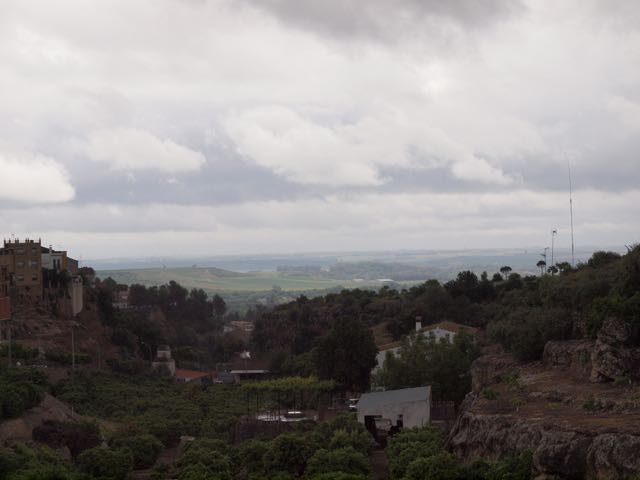
In Hornachuelos a family group were having Sunday lunch on a covered terrace across the other side of the ravine. The voices were amplified by the geography and as we looked across, a woman in flamenco dress swung around a table full of laughter and fun.

The vibrancy and colour speak of a passionate soul. Of a nature that is fiery and explosive. There is no middle ground it seems – no room for the reserved and guarded politeness of the Northern Europeans. A man and a woman sat facing us on the train, talking. Their relationship was probably friends. She said something: only a couple of sentences and his face changed instantly, as suddenly as a summer storm. It was as much as he could do to stop the tears from coming. There was an intensity of feeling almost never seen in public in the northern cultures. The abruptness of the movement from one state to the other was almost astonishing. It was not that his friend had upset him, more, that she had given him some unexpected news. She talked him around, but his struggle to control his passion was completely visible on his face.

In the small geographical footprint that is Europe, there is an immense diversity. Just think of the Italians. As a child I visited Italy a number of times and it seems to me that for them there is not much difference between public and private. Italian life is out there for all to see, in the arguments between scooters and taxis, in the loud voices and laughter around a café table, or the flirtations at the evening promenade.

Contrary to the modesty of the Spanish public persona, where signs of physical affection such as holding hands and kissing are rare. I remember sitting opposite a couple on the underground (metro) in Berlin and thinking that I was about to witness an orgasm. The Germans, to my mind are the opposite to the Spanish. Their private life is richtig and it is in their public lives that they let go. Berlin has to be the graffiti capital of the world – if it isn’t moving draw on it, and if it does move, like a train, then all the better. Nakedness and nudism does not even turn a head and was used in the old East almost as a form of civil protest. Theatre and dress in Germany (Berlin in particular) is as out there as you are going to find anywhere in the world.

Each nationality has its own cultural norms but I had never considered smiling to be one of them.

Undies require two pegs

It is always interesting to go to foreign lands and see their domestic arrangements. For instance, how can life proceed without a kettle? Hairdryers and irons are always found, but kettles rarely. Now we are in Madrid, this is big city living and we are the proud possessors of both a kettle and a bath.

Balconies are an essential in high-rise living and extending from them are washing lines. Sheets flap four floors up and therein lies the necessity of two pegs for your undies on a breezy day. My washing is now hanging on for dear life on the lines that extend out over a neighbours roof. Should their slender hold on the line fail, on whose door do I knock and how do I politely request in Spanish, the return of said underwear. Thank the gods that I am not young and pretty (never was one of those options) or it could lead to all sorts of complications.

Our three apartments have all had a different character. All on the top floor of course with access to the roof or balcony. Imagine our delight to find that there was a lift in Cordoba. No more lugging heavy suitcases up the stairs.

We were very late to arrive at our Madrid apartment due to the fact that it took us over an hour to buy our tickets to Malaga. Good job we did buy them in advance because the cheaper ones were all sold out, and there was only one train that had any of the more expensive ones. This was due to the May-Day holiday, but we didn’t know that at the time. My friend swears extremely rarely and has to be pushed to it. She was, when after waiting an hour to be seen the man at the desk told us to hurry up. He didn’t understand English but then some words are universal aren’t they 🙂

We had arranged to be at the apartment for 3.30, but by the time we finally got there, it was closer to 4.30. We staggered up the steps of the Madrid metro, having been playing pack-horses (or in Spain shouldn’t that be pack-mules) and were most relieved to find the apartment just across the road. However, the result was that Margerita who had waited for us to arrive, was understandably frazzled.

‘Señoras!’ she expostulated, followed by an explosion of Spanish that included hand gestures about mobile phones. ‘No mobile,’ we humbly explain, trying to grovel on the pavement. (See previous blog posts for explanations about our technical deficiencies.) She is marginally mollified, but obviously eager to let us in and get on with her life. She grabs the bag. Her eyebrows go up – as I mentioned mules would have been a useful adjunct to our trip. I say ‘No I’ll take it’ Trying very hard to make up for our lateness ‘No, no,’ she insists, handing me one of the handles. I grab it and off we set up the stairs. She is all fired up and about twenty-five years younger. We race up the stairs with me clinging onto the handle for dear life and wondering if a heart attack is imminent.

When we arrive in the apartment we have a whirlwind tour with me saying,’Yes I know about those, don’t worry explaining’, still trying to make up for lost time. Finally she is smiling and pointing to the gratis bottle of wine and two wine glasses on the table. If I hadn’t needed it so much myself, I might have offered it to her as a peace token.

(Sorry still no photos – much spending of money later I’m awaiting the support person from the card reader company to get back to me. Serves me right for buying a brand new MacBook Air with USB3 ports!)

Moorish is moreish

View from the roof of our apartment

Cordoba has always been a melting pot and today is no different. We wander through streets thick with milling tourists, and for the first time we have struck gold with the marketing opportunities. Tacky tourist shops line the narrow streets. Tiles and dolls, frocks and leather vie for attention. All very expensive and very, very nasty.

The languages flow around us. German, Dutch, English and a smattering of American. A couple from the Bronx argue as they push their way through the crowd. We sit down at a cafe and the table next door fills with a laughing foursome. Must be Italians. Even the discerning French are here en masse. Flocks of French schoolchildren are herded by a few barking sheep-dog teachers.

Today is a day of magnanimity on my part. My friend gets to choose the itinerary. Since we have arrived I have route marched her, whisked her away to obscure locations, dragged her into buildings hardly meriting a mention in the tourist guides, all in the name of a figment of my imagination, a story. But this time she gets to choose, and we are going Islamic. Not even a sniff of Napoleonic.

The Romans were in Cordoba and their grandeur mingles with the Arabs who followed them, the Jews who kept them company and finally the Christians who bludgeoned their way onto the scene around the turn of the first millennium.

Whilst northern Europe was a wild, cold territory fought over by Vikings, Visigoths and Saxon warlords, pillaging and slaughtering their way to power, Cordoba was the largest city in southern Europe, with one million people and the centre of everything cultured, educated and liberal.

We go to the astounding creation that is Cordoba Cathedral. It is not a cathedral, it is really a mosque, whose proportions and beauty so captured the Christian King that conquered the city that he instructed his Muslim architect to construct a church inside it. It is unique, it is beautiful and it is worth travelling across Europe and over the seas to see.

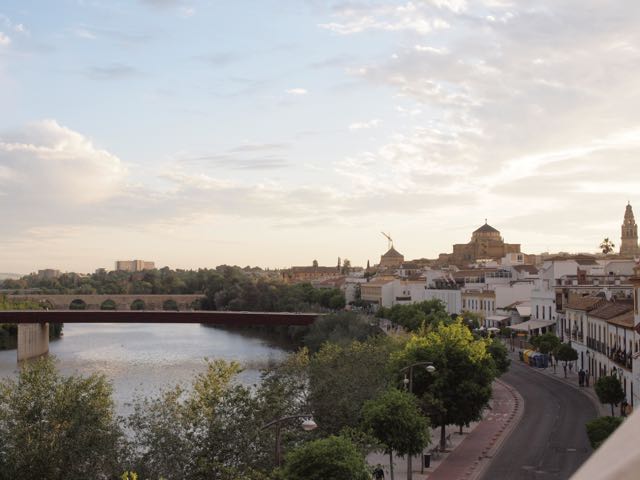
View over the old town, including the mosque and the palace.

It must be worth a photograph, I hear you think. Indeed it was worth very many, but a technical malfunction has wiped all the photographs from my camera for this day. There we were, two old dears, trying send just one photo from my friend’s iPhone to my Macbook. She’s locked out of her email with no phone access (don’t ask, too complicated) but we do have wi-fi. We tried bluetooth and dropbox, but her phone just won’t play, so sorry folks, stock photos only. But I encourage you to google images for Cordoba mosque

From the choked streets, we turn into a narrow alleyway. Everything is white, and suddenly peace descends. The hubbub is gone and we have turned into the old Jewish quarter, where there is a Jewish museum. A little further down is a house that has been restored to show its 11th century origins. It is simple and exotic rugs hang on the wall, water bubbles in a low marble fountain. Plants climb the walls of the courtyard and underneath is a cellar with a well and an old plough doing the service of a handrail on the steps. It tells the story of how paper was made from rags, scraps of the Egyptian cotton used at the time.

From there, via an appropriate lunch of Middle Eastern food we cross the Roman footbridge to the tower and go into the museum. We take an audio tour narrated by someone who was obviously sent to be educated in an expensive English public school (private school). In just 8 rooms we view the splendour and civilisation that was Moorish culture in Spain. We listen to the philosophies of the three religions that all preached peace and harmony. Whilst elsewhere the crusades raged across the Middle East. We view sophisticated and beautifully made surgical instruments and see astrolabes and world maps. It is intelligently put together and very informative, no dumbing down here.

Tomorrow we leave for Madrid and Napoleon will stick his foot in the door again. And we will never know exactly what that peculiar thing we could see under the bridge, actually was.

The Rain in Spain

View South from Hornachuelos

The rain in Spain falls mainly on the plain. Except that today it fell mainly on us and we were in the hills.

Hornachuelos, the gateway to the Sierra Morena. What name could me more enticing and more Spanish? It perches on a ridge formed by two ravines. In the time of my novel, it was a little settlement in the back of beyond, or the back of Burke (please choose appropriate expression for your nationality). But it is old and has the history to prove it.

It is Sunday and Hornachuelos is a small town. What happens on Sunday in small towns across the Christian world? Absolutely nothing. Everything is closed. The streets are empty. The rain is falling.

The views are pretty spectacular, but somehow the thought of standing in a howling gale of driving rain to view them, makes them seem somewhat less so. But I experiment anyway.

We trudge up into the town to find the tourist information. Here is a sign, we dutifully follow the arrow. Here is another, so off we tramp. Then nothing. No sign, no Tourist Information. We do secretly know however, that by this time it will be closed for the siesta, and as it is Sunday, closed for the day.

We have not eaten since nine this morning and the pangs of hunger are gnawing. Below our rainproofs our clothes are darkly wet. We find a bar, it is full of men. We find another, it is full of men. And another and another. We join the men, but there is no food, only beer and coffee. Where are all the women? At home cooking dinner of course.

So back to the car. The rain gushes down the street in torrents. It sloshes out of downpipes onto the pavements and we squelch through it. We drape the seats of the car with the wetness of bags and coats and cameras. Then we set off into the Hornachuelos Nature Reserve, and we climb further and further into the mountains.

It is beautiful. It is worth the drenching. It is wild, it is thick with vegetation, that grows low and verdantly green. Trees and shrubs cover the steeps slopes of the hills that rise and fall like peaks in a choppy sea. We wind around endless bends and very occasionally, there is a hacienda (house) hidden in the scrub.

If I were a French soldier in Napolean’s army, I wouldn’t look forward to marching through here, it is the perfect abode for the Goyo’s guerillas! Another sigh of relief, as the places I have chosen for my book surpass my expectations.

Gully in the Hornachuelos Nature Reserve

Good photos are impossible through the little windows of our Fiat 500 and there is nowhere to stop, so I drink it in and try and hold it in my memory. We see groves of trees that have had the bark neatly stripped from their bases and we wonder why. Then the penny drops, they are cork trees!

We meander to Puebla de los Infantes. The sun has emerged again and there is a garage/servo. We screech to a halt, weak from hunger, it is four o’clock. Bread, cheese and toasted, salted almonds make a wonderful meal. We toss the rind of cheese in little pieces and watch fascinated as the ants amass and drag them into the nest. It will be remembered in the annals of their history as a time of plenty. For us it is time to return home.

We brave the Cordoba traffic and only get lost once this time. Parking the car in the car park down the road, we gather our things, my friend opens the door and closes it again. Lumps of hail the size of marbles ping onto the bonnet. We wait. It stops and we make a dash for it. We reach number 24, the clouds open and the rain siles down. We hurry on. Number 23, the water runs down my neck. Number 22, my dress is sopping again. Number 21, my sandals, which had half dried on the journey home, return to swamp-land. Number 20, we fiddle with the keys and press ourselves, dripping, into the door.

P4272951

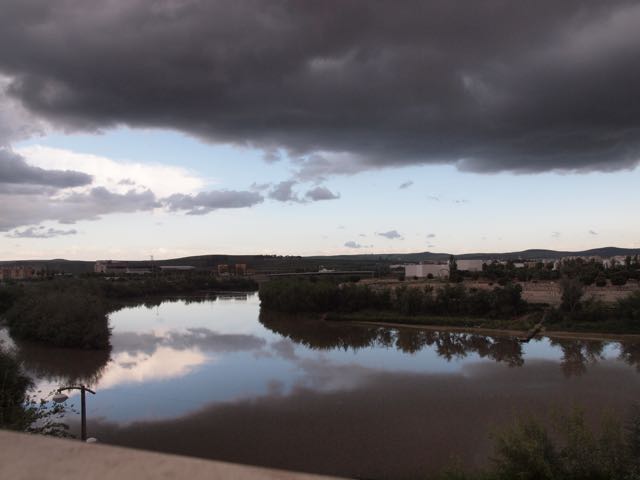
An hour and a cup of tea later we are on the roof. The murky brown of the Guadalquivir river has become cleaner with the run off and reflects the blue of the sky.

The ducks are roosting in the trees like so many Major Mitchells (Australian cockatoo) but so much quieter and more dignified.

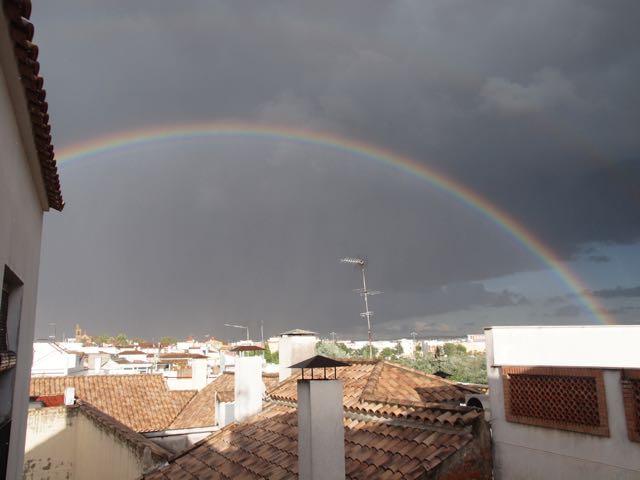
Overhead the sky is still black, the thunder rumbles over the Sierra Morena and a glorious rainbow arcs across the sky.

P4272952

Pining

So we have arrived in Cordoba. What a difference the sun makes, the clouds are covering the sky from horizon to horizon, and the Guadalquivir river is brown. So we are playing spoilt children and pining for sunny Seville.

My friend sets off to do some shopping, just a few things: bread and salad. But she returns nearly an hour later with nothing. We are pining for Lidl (supermarket chain) it was only three minutes up the road. My turn. I walk in the other direction, up the hill and everywhere there are tourists and hostels and hotels. And I am pining for our little apartment in a Spanish bario and where we were serenaded by a music student playing the piano in the next-door apartment. I find some things, but I have to go to the town and it is noisy and busy. I am pining for the quiet streets.

I set off home and to my left is a narrow street and I turn down it. And there are more narrow streets. There are only pedestrians and no cars. The old cobbles rise and fall in waves under your feet and the little balconies jut out overhead. And I feel at home, I am back in the past, the Spain that I have come to see. I am just a tourist after all.

Then the sun comes out and we stand on the roof and admire the view. The little swifts flit and dive through the air, catching their insect dinner. And we laugh. What a difference the sun makes.

Feria de Abril – The Seville Fair

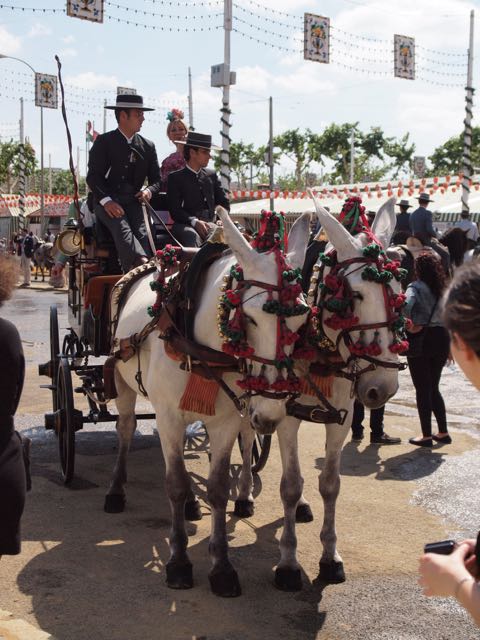
Carriage at the Feria

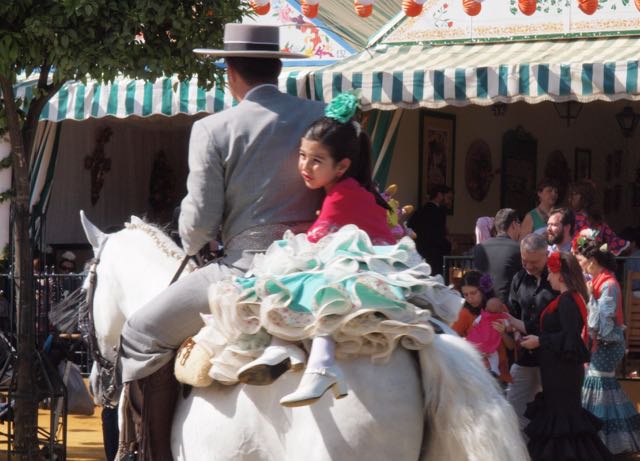
There has been an explosion of colour. It is Divali meets Royal Ascot and the Melbourne Cup rolled into one. It is the Feria de Abril, the Seville Spring Fair. Gone are the sober clothes of simple tailored lines so universally adopted. Everywhere there is colour, frills and furbelows. Flamenco dresses and flowers, felt hats and cummerbunds.

P4232638There are polka dots and candy stripes lined up at the bus stops, sitting side-saddle on the scooters and swaying through the streets. Three kilometres from the Feria the buses are already heaving and camellias and short jackets wait impatiently as bus after bus sails by.

At the roundabout before the bridge, the taxis snarl with the carriages, police whistles blare and arms wave. We join the crowd stretching like a stick of candy over the bridge and under the arch to the Feria!

P4232644

Every horse and mule in Andalucía has been press-ganged into service. The stables for miles around are booked out; the manure crop, a gardener’s dream. They have been brushed and clipped and plaited and dressed and harnessed. They are smothered in bells and pom-poms until they can barely see the way in front of them. And they are pulling every type and variety of open carriage that ever was.

Where have all these carriages come from? Where have they been kept for the rest of the sober weeks of the year? They are parading in their hundreds, jostling for space with pedestrians and pushchairs. Shiny black with yellow wheels, but atop them, a seething froth of life, colour and spectacle.

The Feria is all about parties, private parties. Hundreds of booths, ranged like chalets along the seafront, are filled with tables and a dance floor, friends and families gather and the celebration begins. Music, wine, food and good company: the heart of Spanish life, oh, and the chance to show off.

P4232694Everyone is taking photos and Facebook has gone into meltdown. They pose: backs straight as a ramrod, head tilted high and that proud, fiery Spanish look in their eyes. A young boy rides by on a thoroughbred fit for a prince. He rides as though he and the horse are one, his body hardly moving: the definition of dignity and pride. The young girls snap each other beside the hedge, flowers amassed in their hair. A child leans into her papa, seated sideways on a pad behind the saddle, her legs are barely long enough to dangle over the horse’s hindquarters.

P4232669The music has started and dancers are warming to the task. Elegant arms and bent wrists wind slowly, not professional flamenco, but the homely brand where everyone joins in. It is early yet, the sun is still above the horizon, and as it shades into night, the party continues.

We make our way home across the river to our apartment in the Calle Juzgado, where the only bright colours are the painted pailings of the children’s playground and the music is the sound of the piano two doors down.