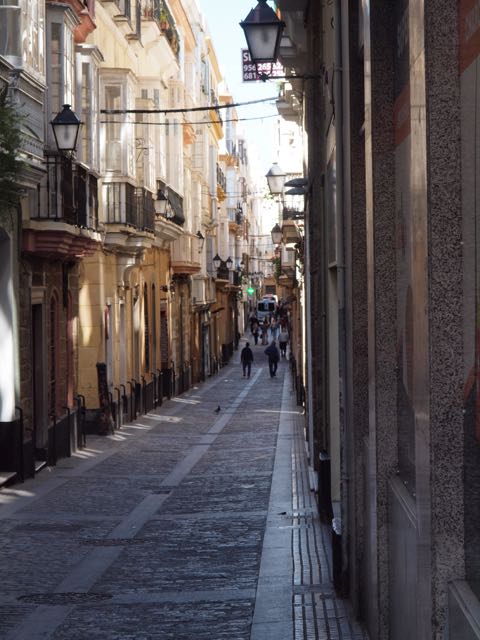
Today we were speed tourists. It might have been somewhat more leisurely had I remembered to turn left. But on we sailed until twenty minutes to the station became forty-five minutes. We arrived just as the train from Seville to Cadiz glided smoothly out of Santa Justa Estacion. We passed an hour in a frivolous manner and finally set out, to arrive at 12.30pm.
Was it going to be possible to research Puerta Real and Cadiz before the train back at 6.40pm? The gods were with us and there was the bus to take us over the harbour bridge. Now I am wandering in places that have not yet appeared in my novel, contemplating events that have not yet happened. My characters start showing me how they arrive and what they see. Are they orange trees in the square, they look like it. Here is the house where the officers stay, here is the house where my heroine hides.
We sit in a cafe and eat empanadas and I drink my friend’s Americana by accident, as she ploughs into my cappuccino. The crema was so thick it masqueraded as milk – too late to swap, I have poured sugar into it in vast quantities. I look idly up the street and remember the swamp we have passed. I knew it was there, but now I have seen it – and suddenly I know what will happen. I scribble a few notes and we walk down to the harbour. Cadiz is a slim outline so very far away across the water. But the sea is calm – could you swim across? Not me, but then a fit young man might.
We find the bus stop and the bus arrives as if sent by the very same gods. Back past the swamps that this time merit photographs and into Cadiz. ‘There’s a Tourist Information, why don’t you try it,’ my friend advises. More to please her than with any expectation of help, I take a short diversion. She was obviously channelling the gods, I am handed a book that outlines a walk celebrating the two hundred years since the Constitution. Joy! Cadiz in 1812, complete with more details than you could shake a stick at, including the house Lord Wellington himself occupied.
We route-march the defensive ramparts overlooking the harbour and yes, it is possible to dive into the sea and not kill yourself. Divine providence! Cheer him on as the young man swims for freedom. Down here, snap, snap, snap round there, snap, snap snap, up this street, snap, snap snap – the camera does the work. We are racing the clock. My friend can go no further without a beer.
‘Oh look, it says here in the guide that Tertulia is the right spelling, not Tertulla as I had thought.’ ‘What’s a Tertulia?’ she asks. ‘It’s a salon – as in, “holding a salon”. Oh wow, have you seen this, there’s a scale model of Cadiz in the late 18C, in the museum – look there’s a picture.’ I am now in raptures. ‘No really, we do have time…’
Cross the square, down this street, turn left, ‘Look there’s the museum – oh 😦 The Museum is closed on Monday. The gods, it seems have got bored and gone to the Tertulia of Señora Larrea to discuss the Enlightenment. Really; how much help did we think we were entitled to?
When we finally sit down to eat back at the little table in our Seville apartment, it is 10pm. Well, how Spanish we have become.
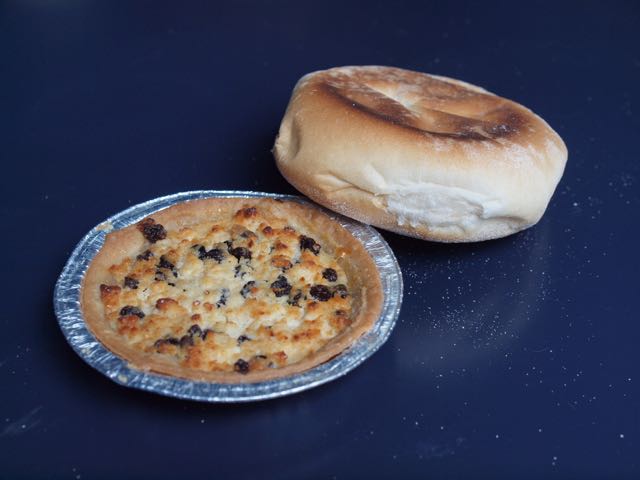 What is it about food that builds its reputation in your memory into a yearning? It’s pretty much possible to get most things English in Australia, where I now live – Marmite, McVities chocolate digestives, red Leicester cheese … But Yorkshire curd tarts, oven cakes (or soft oven bottoms as they are traditionally known) and Atora suet remain elusive. It’s not that the suet itself is the thing – it’s the fluffy, gooey dumplings that I love. And although I have not sourced it myself, I understand that it is available – when I get back I’ll have to seek it out, as it will be the depths of winter by then and I can curl up in front of my wood burning stove and eat thick, chewy stews on top of which suet dumplings ooze.


 Salatheel